

Let’s be real here folks, writing a blog isn’t rocket science- everyone and their dog has a blog these days- however, writing good engaging blog content is a different story. I mean, you’re competing against hundreds if not thousands of blogs with content just like yours, so how are you supposed to stand out from the crowd?
Well, you’re in the right place. Here we will be discussing how to create the most epic long-form content out there and, to give you that extra edge, we also will show you how to repurpose that content to gather the biggest audience for your blog.
Determining an Audience
Determining an audience is one of the most important steps for writing an engaging blog post. How are you supposed to make it engaging if you don’t know who it is for? There are oodles of ways to determine your audience and none of them are right or wrong. Knowing your audience helps a writer create content that is interesting to their readers. Here are two steps we thought of;
Know the demographic.
Your first step to determining an audience is figuring out the demographic you best appeal to. Psychographic and behavioral are two of the most telling segmentations of an audience. To help narrow it down ask yourself these questions about your intended audience;
- What are their hobbies?
- Are they male or female?
- Where do they live?
- What are their lifestyle habits?
All of these are simple ways to narrow down an audience to a specific group(s). Heck, get out there and interview your audience. Do you think you understand the audience you’ve picked? Go out and test it, ask what they want to hear, and see if you’re on the right track.

Brainstorm topics for each possible audience.
Your second step should be narrowing down your potential audiences by listing the issues that could appeal to them. Who do you want to appeal to? What demographic of people would the topic at the back of your mind apply to?
For example, a blog about your top 10 makeup products, will apply to women with a specific age range or our dudes that like to live on the edge. Conversely, content focusing on how to pick up chicks in 3 easy steps would better appeal to our male young-adult population. Now all that’s left for you to decide is which audience you’d rather write for and ask them what they’re interested in hearing; makeup products or pick-up lines. Your engaging blog doesn’t always get to be about things you love, it needs to be relevant and timely for your audience.
Authentic Content
It is difficult at times to narrow your topic down to just one idea. To assist your writing process, always keep your audience in mind. What is your purpose in writing to them? What information do you have that will benefit them that is different from what the rest of the blogs have?
Write about something that you are familiar with. This will make your writing process easier and smoother. It would be useless to talk about something you have no authority on or experience with; that will just confuse you and your reader. It would be like trying to teach someone to play an instrument that you don’t know how to use. Save yourself the embarrassment and spare your audience the pain. Be real and write about something that you already have prior knowledge about. What are your hobbies, your interests, random facts you know?
However, relevancy is the most important thing so do your research if your audience is interested in something you aren’t super familiar with and act like you’ve been an expert the whole time. Keep in mind questions your audience may be asking you. For example, if you run a blog about basketball and you keep getting questions about how to best defeat the opposing team, then write an engaging blog post about your opinion about that. Keep your audience involved by maybe asking them questions in your blog post so you can gain more ideas for future posts.
Keeping your content consistent keeps your audience coming back for more. For example, if you are a flower farmer, you wouldn’t write about your traveling experiences unless they had something to do with vegetation. Your audience came to you for botany advice, don’t let them down!
Research
Once you’ve got your targeted audience and content in mind the real work begins. Research often has people prematurely holding their migraine pills and wishing they could hide hours deep into their favorite Netflix show, but honestly, it is a lot simpler than you would think. So, let’s break it down.
There are two things you want to keep in mind when you’re digging through the internet’s treasure troves of information; first, if you want to write an academic article or just be sure your info is spot on, make sure you are looking at peer-reviewed scholarly sources and second, pull your information from its primary source.

Scholarly sources are easy to find if you are a college student searching through your library’s database. A few filters will get you exactly where you want to be. Surfing the net, however, is a different story. If you’re googling for new information be sure to first type out “Google Scholar” in that search engine. This will give you a better chance of finding articles that are peer-reviewed and validated.
And, to give yourself that extra edge, try interviewing professionals you know who can contribute to your topic. For example, if you’re writing about alpacas don’t be afraid to call up your local alpaca farmer and get some first-hand statements. Who knows, if you’re lucky they might even let you come take some killer pictures for your engaging blog.
People love to share what they know so make sure you reach out to as many first-hand sources as possible and double check that you have their permission to share.
Outline your Content
Don’t try to be a showoff by just jumping into a first draft. Quality content is more likely to be achieved if you have some sort of an idea of where you’re going. Outlining your content is essential to creating beautiful engaging structure in your writing. Here are a few concepts to consider in your outline;
- Hook your reader: A blog is only as successfuland engaging as it is interesting. To entice someone to your blog, you must catch their attention. Begin with a title that will catch their eye and own your topic. Make it short and sweet, a play with words, funny, heartwarming, shocking or unbelievable, or just plain bold. Whatever you do, make it epic.
- Focus on the flow: Creating an even and consistent train of thought that naturally flows into the next section of your blog is imperative for keeping the reader’s attention, once you’ve caught it with a catchy title. Arrange your blog in a uniform and easy-to-follow plan and stick to it. Don’t squirrel off on tangents or side thoughts. Stay focused.
- Use short sentences: How many times has your mind begun to wander as you were reading something with long drawn-out and wordy sentences? Well then, you know what not to do. Reading concise sentences with clear information will help your readers to stay connected.

Headlines and Subtitles
Headlines are crucial to keeping your audience engaged. The key to a good headline is keeping it short. The ideal headline is less than 60 characters. “Google only displays the first 50–60 characters of your title tag”. Headlines should focus on creating Search Engine Optimization, otherwise known as your SEO. Focus on getting your keywords in your headline before that 60-character cut-off.
Get your headlines optimizing SEO by including keywords or long-tail keywords in your headlines. You don’t want a headline so creative that no one will ever find it. For example, don’t title a blog “It’s Hard to Bring Home a New Project” when it’s about how to train your puppy, Instead title it “7 Best Practices for Training your Puppy.” Be sure, however, to add some creativity to your headlines in order for them to stand out from the rest. Your hardest task will be finding the perfect balance.
The second part of the headlines is subtitles. Subtitles follow similar rules to headlines such as keeping their lengths short. They should be between 3-7 words. Your subtitles should break down your categories clearly and specifically. Subtitles need to stand out on your blog, they should be bolded and obvious. This type of subtitle helps with a blog’s scanability. You want your engaging blog to be scannable, as time is money nowadays. Some ways to make it scannable are through bolded words, words in different colors to emphasize importance or italicized words.
Lastly, your headlines and subtitles should add humor to your blog. Create titles that are light-hearted and easy for your mind to digest. Give the people what they want, uplifting content.

Quality Content
Aldo Gucci once said, “Quality is remembered long after price is forgotten.”
Quality content is what keeps your readers hooked from start to finish and keeps them coming back for more. In 1921 Guccio Gucci first started designing leather handbags in a small shop in Florence, Italy. His was a family shop that held quality over quantity. 32 years later his son Aldo opened the first Gucci store in New York City and was awarded a Doctor of Humane Letters degree by the City University of New York for being the “Michelangelo of the merchandising world”. How did a small leather business become an international fashion icon? One bag in an Italian film soon had all of Hollywood and even European Royalty searching for that GG symbol.
Quality attracts attention.
The same principle applies to writing. If you want attention to your blog, you need to produce quality content.

Storytelling grabs your audience’s attention and adds a depth of quality to your content, so be sure to throw in a
- Few humorous tales/experiences
- Use well-known historical tales or personal experiences to add value.
- Meaningful allegories to your work
- For example, as seen in the story above, “One bag in an Italian film soon had all of Hollywood and even European Royalty searching for that GG symbol.”
- Showing your work instead of telling your audience everything
- Graphic above.
Visualization can come from graphics, photos, and good writing.
If you’re teaching folks how to graffiti a monkey DJ on the side of a building, use details and imagery to really break it down. Don’t make them fill in the blanks.

Graphics and Images
It is always important to have images and graphics in your engaging blog post. It keeps the readers engaged and interested. Reading paragraph after paragraph can be fun for some people, but others, want to see graphics that help sum it up. There are a few important steps to remember when using graphics and images.
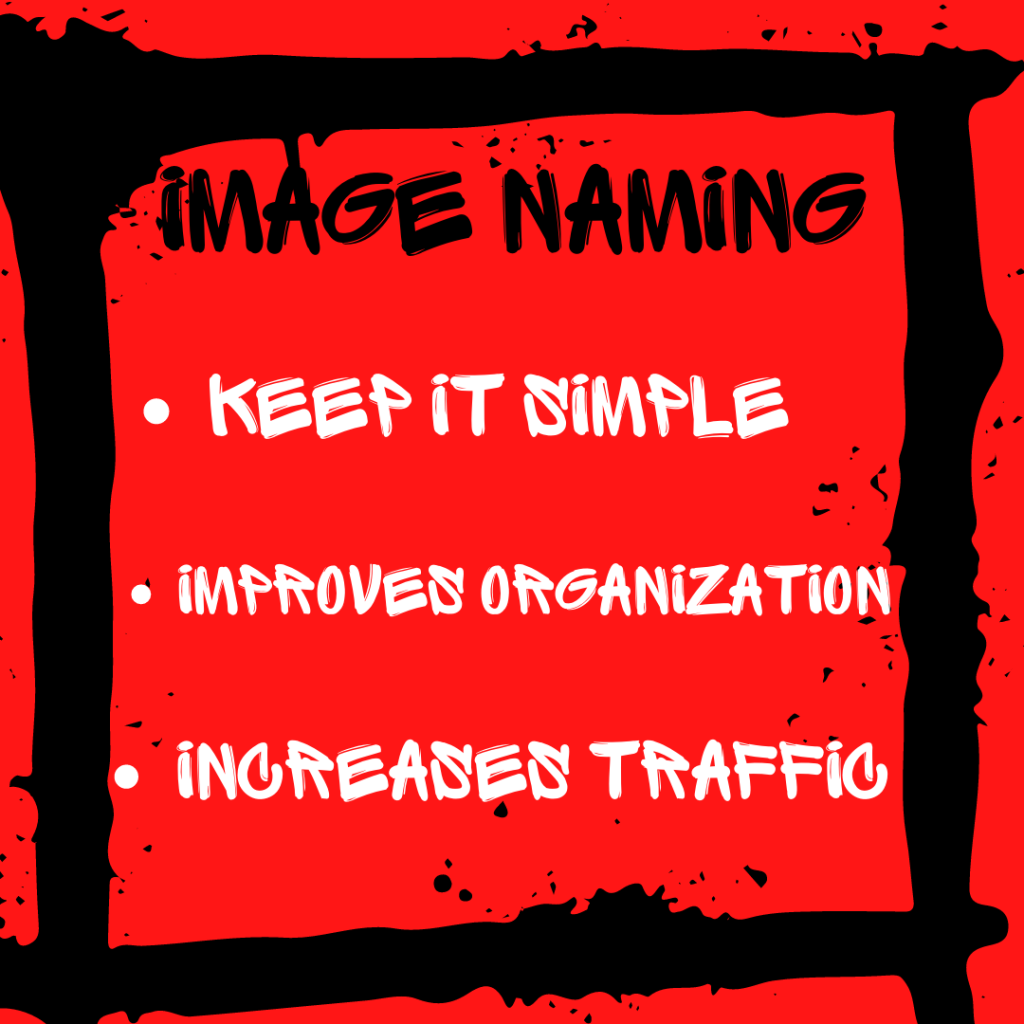
First, it is always important to name your images. It doesn’t have to be complex, but if I have an image of a white dog on green grass with a blue sky behind it, I could name it “white dog, and blue sky”. This helps keep things organized for you on the back end and (depending on the blog site used) gives a good descriptive name for viewers.
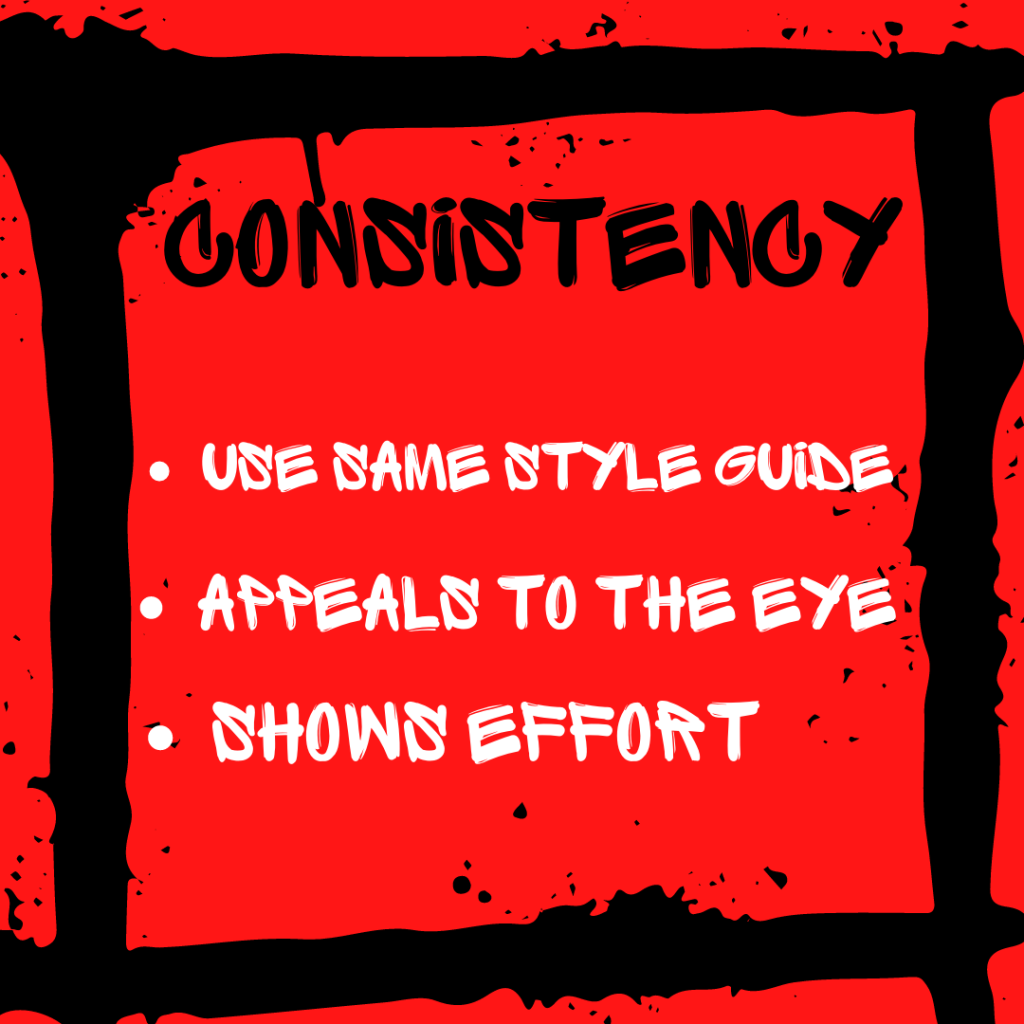
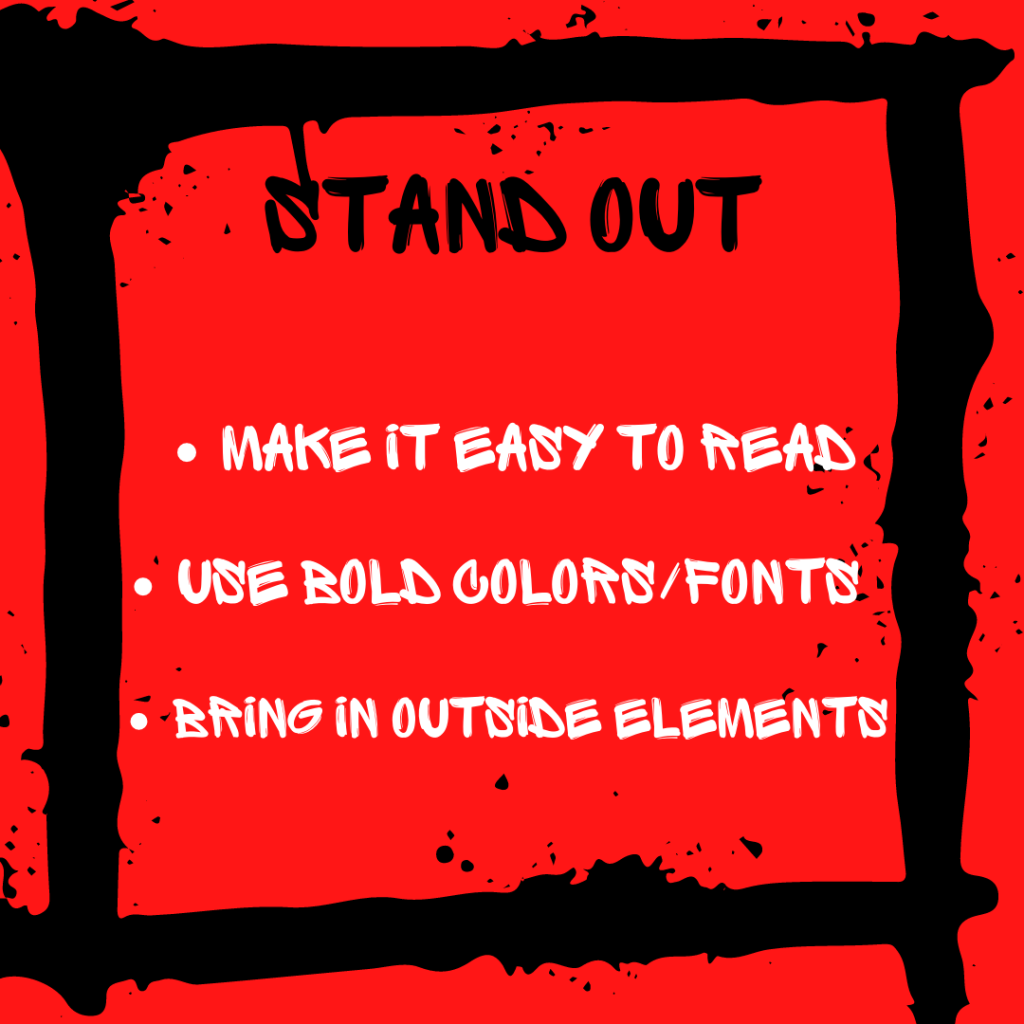
The second thing to remember is to make your images bold. If you are making a food blog for easy meals and want to have your image stand out, ask yourself some questions. How can you do this? What will make your images unique and appealing to the reader? Add outside elements! Add props to make your image better! And make your images consistent! If it is a graphic or image, use the same ‘style guide’. Consistency unifies all of the information given.
Edit
Editing is another one of those things few of us eagerly anticipate, so don’t do it all at once! Break down the editing process by picking one thing at a time to focus on. Your first time reading through your work you may want to just focus on spelling errors. Did you use the right their, there, or they’re? What about the names you included, did you double-check their accuracy? Next, focus on your grammar. Are there quotation marks where you need them? How are your commas looking? You don’t have to be an English major to catch most of your editing errors. Focus on making sure it reads smoothly and is formatted in an appealing way. Read it out loud to get a better feel of the flow.
Once you’ve done all you can to tighten up, ask others to look over your work for you and hire an editor or use an editing program such as Grammarly. The more eyes you get on your piece before publishing, the better. Ask your roommates, coworkers, and your great grandma to read through your content looking for errors. This will not only help your editing but will help get the word out there that you’re about to publish a cool new piece.
Pull Together and Promote
Finally, it’s time to put your piece out there. The most rewarding part of the process doesn’t mean your work is over. Now is the time to add those magical finishing touches. There are two things you’ve got to do to really liven up that content.
First, end with a call to action. Invite your audience to do something, anything! From checking out more articles on your impressive and engaging blog, to living more eco-friendly, make sure you don’t leave your audience wondering what to do next. Your call should pertain to your branding/business while also enticing your audience to actually act. So, if you’re an online website dedicated to helping people improve their long-form content you probably want your audience to check out more of your work like these other articles here. After that you probably want to inspire them to go out and create their own innovative content *wink wink*.
Once you’ve called them to act, give them an easy way to share your content. Repurposing is one of the most effective ways to gain viewers and get the word out there. Social media owns advertising right now so don’t be afraid to use it. Pull quotes, short videos, or awesome graphics to add to Instagram stories, Pinterest pages, and Facebook posts. Shareable content means more traffic through your work. Get. That. Content. Repurposed. Smaller bites are easier to chew so break it down and spread it out.
Conclusion
If you’ve made it this far that means you are dedicated to perfecting your work. Good for you! Keep these eight easy steps close by as you create your next engaging blog post.
- Determine your audience
- Pick your topic
- Outline your plan
- Organize your content with headlines and subtitles
- Use quality in your content
- Don’t forget your graphics and images
- Edit, edit, edit
- Promote
If you stick to these moves, your final project will be sick and shareable! So, get out there, get to work, and be sure to tag us in your victory post!
You can find us on Facebook, Instagram, X, TikTok, LinkedIn, and Threads.
Also, Check out our other blog posts if this was helpful!
Recent Comments