
LinkedIn is the world’s largest professional networking platform used by more than 900 million users worldwide. You may have dabbled with it during college or been required to include your LinkedIn profile along with your resume and cover letter when submitting a job application. Over 87% of recruiters actively use LinkedIn when it comes to evaluating job candidates and other recruitment efforts.
Having said that, it’s quite easy to just let your LinkedIn profile sit on the platform. Sure, you would use it for job applications, networking events, and other related professional occasions, but what else is there to do?
In this article, we’ll talk about:
-optimizing your LinkedIn profile
-networking and making connections
-showcasing your work
-searching for jobs
To understand just how useful it is to be an active user and practitioner on LinkedIn. Let’s take a look at the reasons why LinkedIn became the reputable networking site it is now.
LINKEDIN’S REACH
LinkedIn has over 67 million companies listed on the site, with 140 job applications submitted every second. 61 million people use it in their job search each week.
A recent study found that 122 million people received an interview through the social media platform. Additionally, over 35.5 million of them landed a job and got hired through the site. That’s a turnaround number of about 29% of the people who used LinkedIn for their job search.
LinkedIn’s longevity, searchability on the Internet, and its reputation as the internet’s professional networking site are why you should be using LinkedIn and capitalizing on such a useful professional tool. With this in mind, let’s dive into some tips, tricks, and best practices to maximize your LinkedIn experience for your job search.
OPTIMIZING YOUR LINKEDIN PROFILE
KEEP YOUR PROFILE UP TO DATE
It is important to update your profile often to catch the eye of businesses you are interested in. This allows companies to see your accomplishments and how you would benefit their company. Updating your profile allows the business lenders to see your profile and compare it to requirements that are mandatory for the job.
LinkedIn has over 40 thousand skills listed and 50% of hiring managers look at skills data when looking for qualified candidates. Tailor your skills to match the type of job you are looking for and the qualities listed in those job descriptions. Make sure to keep your skills up to date.
If you update your profile with the standards and requirements needed for the job you are looked upon higher than those who do not meet many of the requirements. LinkedIn has millions of members. There are many job opportunities, but hundreds of people may be looking at the same job.
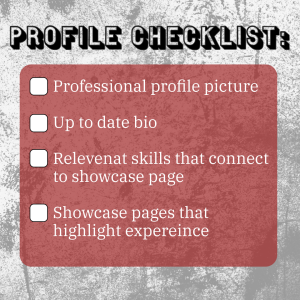
Your profile picture matters because it might be the first impression you make on the company you’re looking to work for. Your first impression is key before they even look at your certifications or experience. It is highly recommended to add a profile picture to your LinkedIn account. Adding a picture to your resume on the other hand is more of a grey area that depends on the company.
SHOWCASE YOUR EXPERIENCES
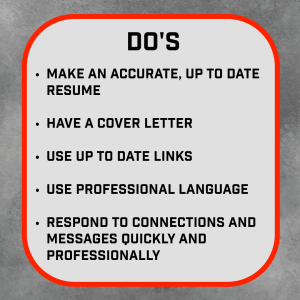
Showcasing your experiences helps to entice hiring managers to view your profile. Your profile is your chance to expound on your skill set with corresponding examples of your experiences. This helps hiring managers see if you are the right fit for their company and the job you are applying for.
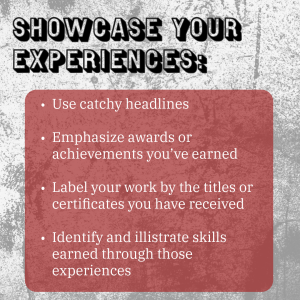
Relevance is key. You don’t have to list every single job experience you’ve had. Your LinkedIn account comes with 10 free showcase pages. Be decisive about it and only list the most relevant and recent experiences. Choose ones that highlight the skills most applicable to the jobs you are looking for.
Now that your profile is optimized and your showcase pages are ready, let’s dive into the different ways to network. This next step can make a huge difference in the success you see in your job search.
NETWORKING ON LINKEDIN
The greatest ally in your LinkedIn job search is your professional network. It is vital to your success to build and foster strong connections on Linkedin. Here are some simple steps to begin capitalizing on your network:
STEP 1: CONNECT WITH YOUR PEERS
Your peers can be friends, family, coworkers, classmates, anyone in your desired field or who may have connections with someone in your field or company. Connect with the alumni from your school, especially those who chose your same degree and career path. You can go to Linkedin.com/Alumni for a list of individuals who graduated from your school and where they are currently working. When building your professional network is it important to remember quality vs. quantity. While it is generally good and advised to make several connections, the quality of the connections is what benefits your job search. For example, having 10 connections with individuals outside of your career or degree is not as beneficial as having 1 connection with an individual who is in your career of choice or who is in your preferred company.
STEP 2: FOLLOW COMPANIES AND CONNECT WITH THE EMPLOYEES
Follow companies that you have an interest in and connect with employees in your desired department. Connecting with these individuals shows your interest in the company and their experience. Take some time on each individual’s page to learn more about them and see what you have in common or what you could benefit from connecting with them, take note of these individuals for later. Quality vs. quantity applies here as well.
It is important to note that when you visit an individual’s page, the same individual gets a notification that you visited their page with your name and a link back to your page. This is a great asset when it comes to your job search because it puts your name and face on an individual’s radar. In the future, your name may come across their desk and chances are that they will be more familiar with you than your competitor because you took the time to connect which in turn may give you a leg up in the hiring process.
STEP 3: CONNECT WITH RECRUITERS
Two types of recruiters on LinkedIn that are important to note during your job search. First, is a recruiter who is employed by the company and works in-house to find capable and quality candidates. Second, is a recruiter who is employed by a staffing agency or third party to fill positions for several companies. The first is a greater asset to you in your job search than the second.
Recruiters employed by the company know the company and culture better than third-party recruiters. They know what they are looking for and who would be best suited for different positions. You will find that most large companies such as Amazon, Johnson & Johnson, and Google have in-house recruiters and departments dedicated to finding the right individual for the culture and positions of the company. These individuals typically know right away if you are a good fit or not for the company. Trust them.
Recruiters employed by staffing agencies likely don’t have experience with the culture of the company and are working off a sheet of requirements for the job. They get paid for every position filled and not necessarily that they fill the position with someone best suited for the company and its culture. While we cannot speak for all recruiters, the HR professionals we surveyed said that these types of recruiters often don’t care about the quality of the candidate or the possibility of you fitting into the culture and company and care more about checking off a set of requirements. If you are working with a recruiter from a staffing agency, take additional time to talk to individuals from the company to get a feel if you are a good fit or not.
In everything that you do on LinkedIn, it is important to be genuine and show your true personality. With recruiters, however, it is especially important and vital to your success to be genuine.
Remember, when speaking to recruiters:
- Engage in conversation
- Ask good questions
- Showcase your genuine self
- Personality > Cookie Cutter responses
STEP 4: CREATE AN ACTIVE AND ENGAGING PRESENCE
LinkedIn began as a social network and while it has expanded into so much more the social networking aspect remains the same. Just as you would engage with your followers on Instagram or Facebook, you should engage with your connections on LinkedIn. For example, you can like and comment on individual posts, share their content, and publish your work. Remember the point made before on being genuine? This is also true when creating an active and engaging presence. Don’t like, comment, or share items that don’t feel genuine to who you are and your brand. Be consistent in your engagement and conversations.
STEP 5: PUBLISH YOUR WORK
As college students, you have done projects, research papers, visual content, and so much more for your education. Don’t let your hard work sit in a folder on your computer forever, share them on LinkedIn for potential employers to see. LinkedIn is a great place to showcase your portfolio, share the things you are interested in, and showcase your talents. When uploading your work make sure to upload a relevant image attached to your content and add a clear and concise description so individuals can quickly understand what they are seeing.
STEP 6: INTRODUCE YOURSELF AND ENGAGE IN CONVERSATION
Messaging individuals in your field or preferred company can grow your connections and lead to mentorship and possibly employment. In Step 2 we created a list of individuals who you felt had something in common with you and you could easily connect with. Start with these individuals and work from there. Your initial message can start by congratulating them on their accomplishments, wishing them a happy birthday, asking a question relating to their brand, or connecting with them on your common interest. For example, your message may look something like this:
“Hi Mason, I wanted to reach out and connect with you. I am impressed by your career progression in Marketing and your current employment at Google. I am early in my career and applying to several Marketing positions at this time. Could you give me any advice?”
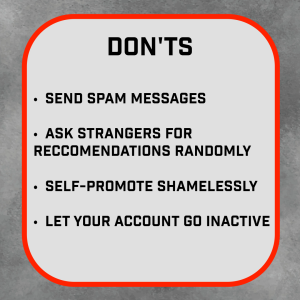
Be consistent in messaging, your initial message should not be the last message you send them and it should not be a cookie-cutter message that you copy, paste, and send to multiple individuals. Your message must be genuine and personalized to that individual and to yourself. Professional connections take time and attention to cultivate and the more genuine the connection the more likely they will remember you when a job opportunity arises. Don’t be afraid to reach out even if it is someone you don’t know or haven’t spoken to in a long time.
JOB SEARCHING ON LINKEDIN
Now that you are established on LinkedIn and capitalizing upon your network, you are ready to begin your job search. First, HR professionals suggest beginning your search by utilizing your strong network and creating a post that you are looking for employment in your particular field and encouraging your network to provide any connections that they have.
Next, make a list of what you are looking for (ie. job title, skill, or company) and what locations you would like to work in. Click the “Jobs” tab at the top of your page and enter those items into the “Search for your next job” box. As you are looking through available job postings, take your time and review the job descriptions to make sure your skills fit what’s required for the job. If your skill set meets the requirements, apply to the position.
The HR professionals we interviewed suggested that you pay careful attention to the verbiage in job postings, specifically in the job description, and use the same verbiage in your resume to describe your credentials before you apply. Several employers nowadays use AI to filter resumes into a possible applicant pile and a rejection pile. AI looks for specific verbiage and qualities that were mentioned in the initial job posting.
If your resume doesn’t have those qualities listed, it will not pass the AI test and will not be put on the pile of possible applicants. In the weeks following your application submitted, refer back to step 6 and engage with employees at the companies you applied to or reach out to the recruiter or employer reviewing your resume.
Today many employers are using LinkedIn to recruit and find candidates versus times of the past when they would review paper resumes submitted to them. This was true for Eric Eyster, currently working for Amazon doing HR at one of their cross-dock facilities in Charlotte, North Carolina. At the beginning of the Coronavirus pandemic, Eric found himself among so many others laid off from a steady job doing HR for an automotive manufacturer. The first thing he did was update his LinkedIn profile and post that he was looking for employment.
From there he began applying and connecting with individuals in his field when undenounced to him, a recruiter from Amazon picked up his profile. Impressed by his profile, connections & resume they reached out to him about a position in their cross-dock facilities where he was interviewed and offered the job. “I never applied to this position with Amazon, they reached out to me,” said Eric. During the interview process, Eric connected with individuals at the particular cross-dock and within the HR division of the company and built strong connections. Through those connections, he was about to learn more about the specific position and his potential with the company in the future.
He also gathered great advice to utilize in the interview that in turn helped him land the job. In our interview, Eric said, “My LinkedIn profile significantly impacted my employment with Amazon. Without it, I may have not been able to get this position.” Your experience may not be the same as Eric’s however, it is valid to say that having a strong LinkedIn profile and genuine connections can significantly increase your chances of getting a job.
To those who are currently looking for employment, Eric says, “Be engaged and network with individuals who are experienced in the field in which you desire to grow. LinkedIn has so much to offer you if you put the work into it.”
LinkedIn can be extremely beneficial as you begin your job search/career. Following the steps provided above (list the steps, profile, networking, searching) can ensure your job search ends in success. Your future truly is at your fingertips.
Recent Comments